
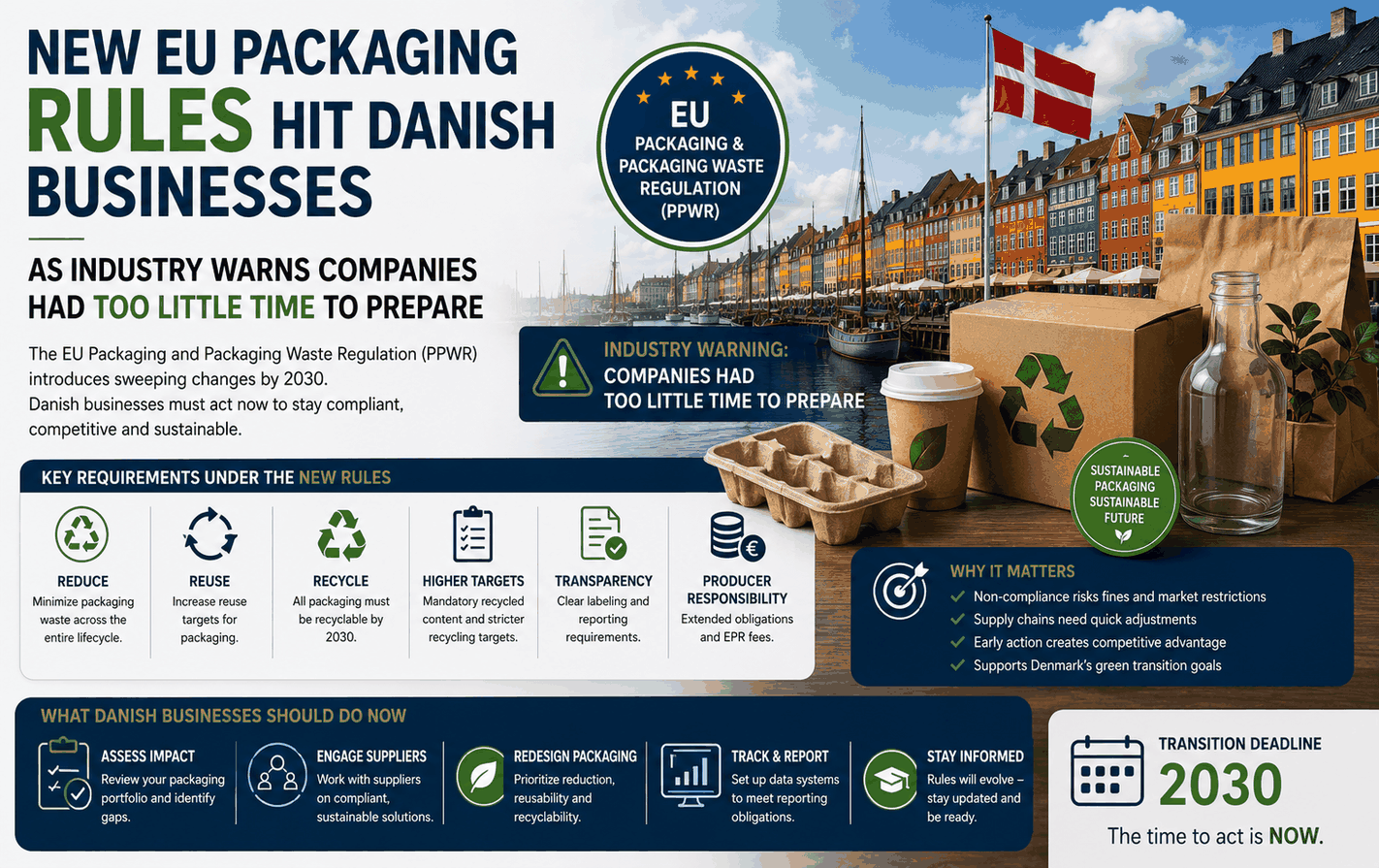
Danish businesses are adjusting to a major new set of European packaging requirements after industry representatives warned that companies were given too little time to understand and implement some of the rules.
The first requirements under the EU’s Packaging and Packaging Waste Regulation, commonly known as the PPWR, started applying across the European Union on August 12, 2026.
For companies selling packaging or packaged products, the changes are far more than an environmental policy announcement. Businesses can now face requirements involving documentation, packaging identification, heavy metals and potentially PFAS in food-contact packaging.
The transition has not been smooth.
Confederation of Danish Industry, known as DI, criticised the limited preparation time available to businesses, saying central guidance arrived only shortly before the new requirements became applicable.
Danish authorities have since indicated that they will take a pragmatic approach to supervision during the initial period while businesses adjust.
The situation highlights a wider challenge facing companies in Denmark: European environmental regulation is increasingly becoming a matter of day-to-day corporate compliance.
What Changed on August 12?
The PPWR is designed to create a more consistent European framework for packaging and packaging waste.
The regulation entered into force in February 2025, but its general application began on August 12, 2026.
According to the European Commission, the wider objective is to reduce the environmental impact of packaging while strengthening the EU single market and encouraging a more circular economy.
For businesses, however, August 12 brought several immediate practical requirements.
Denmark’s Environmental Protection Agency says that companies must now pay attention to requirements including:
- Declarations of conformity for packaging
- Identification information connecting packaging to relevant documentation
- Manufacturer or importer information
- Limits on specified heavy metals
- PFAS limits for food-contact packaging
- Technical documentation supporting compliance
This means packaging is increasingly becoming something companies need to document, not merely purchase.
Danish Industry Says Businesses Had Too Little Time
The timing of practical guidance has become one of the biggest controversies surrounding implementation in Denmark.
DI argued that it was unreasonable to expect businesses to achieve immediate full compliance with extensive requirements when important guidance became available only shortly before implementation.
The organisation said companies needed time to collect supplier documentation, map packaging, understand environmental requirements and establish processes for passing necessary information through the supply chain.
This is particularly significant for companies dealing with large numbers of products.
A retailer, importer or manufacturer might use dozens or even hundreds of different packaging combinations. Each could involve different materials, suppliers and documentation.
What sounds like a packaging rule can therefore quickly become a substantial data and compliance project.
Authorities Signal a Pragmatic Start
The concerns have received a response from Danish authorities.
According to DI, the Danish Energy Agency indicated that it recognises businesses need an opportunity to adapt to the new requirements and that it will initially exercise discretion in its supervisory activities.
DI welcomed the announcement, particularly because companies had faced limited time to understand some of the practical requirements.
That does not mean businesses can simply ignore the rules.
Instead, the early approach appears intended to emphasise guidance and dialogue while companies build the necessary compliance processes.
For businesses, there is an important distinction between authorities allowing time for practical adjustment and the underlying legal requirements not applying.
The rules are already in application.
Packaging Is Becoming a Corporate Compliance Issue
The development is relevant to companies following Danish and international regulatory changes through Lead Roedl because packaging rules now touch areas extending well beyond environmental policy.
Businesses may need to review supplier agreements, technical documentation, internal responsibility, product information and cross-border supply arrangements.
Responsibility also varies depending on the company’s role.
A manufacturer has different obligations from an importer or distributor. Businesses therefore need to understand where they sit in the supply chain and what responsibilities follow from that position.
This can be especially important for international businesses selling products into Denmark without a large local compliance department.
A Declaration of Conformity Is Now Important
One of the most practical changes is the declaration of conformity.
Before packaging is placed on the market, a declaration must be prepared to demonstrate that the packaging complies with the applicable requirements.
According to Denmark’s Environmental Protection Agency, the declaration covers the complete packaging, including where it consists of several components.
It should identify the packaging and provide information including the manufacturer’s name and address.
It also needs to refer to relevant EU legislation and applicable standards or technical specifications.
Behind that declaration sits another layer of compliance: technical documentation.
Companies Need Evidence Behind the Declaration
A declaration cannot simply be treated as another form to sign.
Manufacturers need technical documentation allowing compliance with the applicable packaging requirements to be assessed.
Depending on the packaging, documentation can contain information concerning:
- Intended use
- Design
- Manufacturing
- Component materials
- Technical specifications
- Relevant standards
- Assessments
- Test reports
Suppliers also have an important role.
Packaging and packaging-material suppliers are required to provide manufacturers with information and documentation necessary to demonstrate compliance.
That could include information about materials, substances, testing and food-contact requirements.
This makes supply-chain cooperation increasingly important.
A business cannot demonstrate compliance easily if its supplier cannot provide the necessary information.
Packaging Must Be Identifiable
The rules also introduce important identification requirements.
Packaging needs to contain information allowing the responsible manufacturer or importer to be identified.
According to Danish guidance, this includes the manufacturer’s name, registered business name or trademark and a postal address where the business can be contacted.
Packaging also needs an identification number.
This could operate at type, batch or serial-number level.
The purpose is practical: authorities and businesses need to be able to connect a particular package with the declaration of conformity covering it.
If the nature or size of the packaging makes direct information impossible, some information can instead appear on accompanying documentation or labels.
For businesses with extensive product ranges, implementing consistent identification systems could require significant operational changes.
Heavy Metals Are Part of the New Requirements
Chemical content is another important part of the new regime.
Packaging placed on the market from August 12 must comply with applicable limits concerning specified heavy metals.
Danish guidance identifies a combined limit for lead, cadmium, mercury and hexavalent chromium.
Businesses may therefore need reliable information about the materials used in their packaging.
For companies purchasing packaging from external suppliers, asking for appropriate documentation becomes particularly important.
A purchasing department that previously selected packaging mainly according to price, design and durability may now need to incorporate regulatory documentation into supplier decisions.
PFAS Rules Could Have Immediate Consequences for Food Packaging
Food-contact packaging receives additional attention.
From August 12, the PPWR applies limits to PFAS in food-contact packaging.
PFAS are a large group of synthetic chemicals that have attracted increasing regulatory attention because of their persistence in the environment.
The European Commission confirms that food-contact packaging containing PFAS above the regulatory limits can no longer be placed on the EU market.
An important detail concerns existing stock.
The Commission’s 2026 PPWR guidance says there is no general transitional period allowing companies to exhaust stocks of non-compliant PFAS food-contact packaging simply because the packaging was produced before August 12.
Food-contact packaging placed on the market after that date must comply with the applicable PFAS limits.
Packaging already placed on the market before August 12 does not need to be withdrawn merely because of the new limits.
This distinction could matter significantly to manufacturers, food businesses, importers and distributors managing existing inventories.
Foreign Companies Selling Into Denmark Should Pay Attention Too
The regulation is European, which makes the issue especially important for cross-border businesses.
A foreign manufacturer cannot assume that packaging compliance is exclusively the responsibility of its Danish customer.
Depending on how products enter the market and the company’s position in the supply chain, responsibilities can fall on manufacturers, importers and other economic operators.
Danish authorities also note that businesses importing and making packaging available in Denmark can be affected by Denmark’s producer-responsibility framework.
International companies should therefore examine both the PPWR product requirements and any separate Danish producer-responsibility obligations relevant to their activities.
This is another example of why entering the Danish market requires more than simply checking whether a product itself can legally be sold.
The packaging surrounding that product can create its own compliance obligations.
Businesses Face Two Packaging Challenges at Once
DI has pointed to another source of frustration.
Companies are not only implementing the new EU environmental requirements. They have also been dealing with Denmark’s extended producer responsibility system for packaging.
According to DI, uncertainty surrounding costs and administrative arrangements has already created difficulties for businesses.
The arrival of the PPWR adds another compliance layer.
Companies therefore need to distinguish between related but different questions.
One concerns whether packaging itself complies with European requirements.
Another concerns who has producer responsibility for packaging waste and associated reporting and financial obligations.
Treating the two systems as if they were identical could lead to compliance gaps.
Supplier Contracts May Need Another Look
The new rules could also affect commercial relationships.
If a manufacturer depends on a packaging supplier for chemical-content information, test reports or material specifications, it needs confidence that those documents will be available.
Companies may want to review contracts to determine:
- Who must provide compliance documentation?
- How quickly must documentation be supplied?
- Who is responsible for testing?
- What happens if packaging is non-compliant?
- Who bears the cost of replacing unusable packaging?
- Does the supplier have to notify the customer about material changes?
- Are warranties regarding regulatory compliance sufficient?
These questions can become particularly important where packaging is sourced internationally.
A low-cost supplier becomes considerably less attractive if missing documentation prevents products from being placed on the European market.
What Should Businesses Do Now?
Companies affected by the August rules should focus on understanding their packaging portfolio and their role in the supply chain.
A practical review could begin with several steps:
- Map the packaging used across products
- Determine whether the business is a manufacturer, importer or distributor for relevant packaging
- Identify which declarations of conformity are required
- Obtain technical documentation from suppliers
- Check manufacturer and importer information
- Establish packaging identification systems
- Review heavy-metal compliance
- Examine PFAS compliance for food-contact packaging
- Check existing inventory
- Review supplier contracts
- Separate PPWR compliance from producer-responsibility obligations
- Assign internal responsibility for ongoing packaging compliance
Documentation should be treated as an active compliance process rather than a one-time exercise.
Packaging designs change. Suppliers change. Materials change. Products are introduced and discontinued.
The company’s records therefore need to keep pace.
More Packaging Requirements Are Coming
August 12 is not the end of the PPWR story.
The regulation introduces requirements progressively over the coming years.
Future measures include further rules involving labelling, recyclability, recycled content, packaging minimisation, reuse and other areas.
The European Commission says the regulation is intended to reduce packaging waste while creating common rules across the single market.
For businesses, common European requirements could eventually make cross-border compliance easier.
The immediate transition, however, is proving difficult for some Danish companies.
A Green Regulation With Very Practical Business Consequences
The debate in Denmark shows how environmental regulation is changing.
Packaging policy might once have been viewed primarily as an environmental or waste-management issue.
In 2026, it involves legal documentation, chemical restrictions, supply-chain information, product identification, contracts and regulatory supervision.
The fact that Danish industry publicly raised concerns about implementation time demonstrates how significant these operational requirements can become.
Authorities’ willingness to take a pragmatic approach during the initial supervisory period may give businesses some breathing room.
But it should not be confused with an exemption from compliance.
The PPWR is already applying, and companies placing packaging and packaged products on the market need to understand what that means for them.
For Danish and international businesses alike, the safest response is not simply to ask whether their packaging looks sustainable.
They need to be able to show what it contains, who is responsible for it and where the evidence of compliance can be found.