International summits are usually filled with handshakes, formal statements and carefully chosen diplomatic language. But during Malaysian Prime Minister Anwar Ibrahim’s latest visit to India, one of the most memorable moments was far more personal: a promise to his wife that took four decades to fulfill.
Speaking about his India visit, Anwar revealed that he had once promised his wife that he would take her to see the Taj Mahal after they got married. The promise was eventually kept—but it took around 40 years.
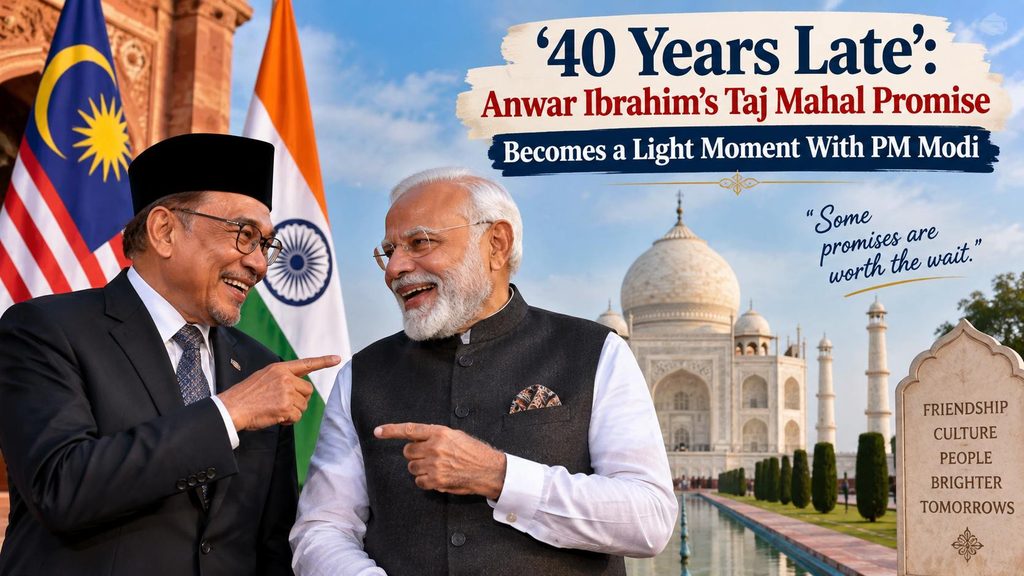
And Anwar turned the long delay into a joke.
He said he told Prime Minister Narendra Modi that politicians are not always known for keeping their promises. But, in his case, he could at least claim that he eventually delivered.
His punchline was simple: he does honor his promises—just 40 years late.
From a 40-Year Promise to a BRICS Moment
The anecdote offered an unusually personal glimpse of Anwar during a visit dominated by diplomacy.
Malaysia’s prime minister was in New Delhi for the 18th BRICS Summit, where Malaysia participated as a BRICS Partner Country. He also held a bilateral meeting with Modi on September 12.
The official discussions were anything but light-hearted.
India and Malaysia reviewed cooperation in trade and investment, defense and security, semiconductors, infrastructure, digital technology, energy, fintech, education, tourism and people-to-people ties. The two leaders also discussed regional and global issues and reaffirmed their commitment to the India-Malaysia Comprehensive Strategic Partnership.
Against that formal backdrop, Anwar’s story about the Taj Mahal offered a very different side of the visit.
Why the Taj Mahal Story Stood Out
For Anwar, the Taj Mahal was not simply another tourist attraction.
He explained that the visit fulfilled a promise he had made to his wife when they were newly married. Four decades later, he was finally able to keep it.
Anwar also spoke warmly about his wife and her role during difficult periods of his life, describing her as someone who was “soft but strong.” He said she deserved the opportunity to finally make the long-awaited visit.
That personal explanation gives the joke a little more meaning.
What initially sounds like a joke about politicians and promises was also a story about marriage, patience and a commitment that survived decades of political and personal change.
Anwar Turns Political Humor on Himself
The Malaysian leader’s comment was also notable because he made himself the target of the joke.
Rather than using the familiar political line that promises are difficult to keep, Anwar used his own experience as the example.
He had promised something.
He took an extraordinarily long time to deliver it.
But he eventually did.
That allowed him to joke with Modi that he could still defend his record as a promise-keeper—just not a particularly fast one.
The remark was made while discussing his India visit in an interview with Thanthi TV.
A Warmer Side of a Strategic Relationship
The personal exchange came at a time when India and Malaysia are trying to deepen a relationship that extends well beyond traditional trade.
Their bilateral ties were elevated to a Comprehensive Strategic Partnership in 2024. Since then, cooperation has expanded across technology, defense, investment and other areas.
During the September 12 meeting, semiconductor cooperation received particular attention. Malaysian officials said Anwar and Modi discussed integrated supply chains, talent development, two-way investment and opportunities to translate semiconductor cooperation into industry partnerships.
This is increasingly important because semiconductors have become a strategic industry for both governments.
The relationship is therefore not simply about diplomatic ceremonies. It is also about where factories are built, where technology talent is developed and how supply chains are connected.
The Visit Had a Strong Cultural Side Too
Anwar’s appearance in India was not limited to meetings and policy discussions.
He also attracted attention for his affection for Indian music.
At a BRICS gala dinner in New Delhi, the Malaysian prime minister surprised attendees by singing Kishore Kumar’s classic Hindi song “Khwaab Ho Tum Ya Koi Haqeeqat.”
That performance added another cultural dimension to a visit already generating attention for his personal connection with India.
For a diplomatic trip, the combination was unusual: formal negotiations during the day, followed by music, humor and personal stories.
Anwar and India’s Tamil Connection
The Malaysian prime minister also spoke about his relationship with Tamil Nadu and his interactions with Tamil Nadu Chief Minister Vijay.
Anwar said he has friends in both Malaysia and Tamil Nadu who closely follow politics in the state. He described Vijay as a young political leader whose rise has been rapid.
He said he had advised Vijay that winning elections and governing are different challenges, drawing on his own political experience.
Anwar also said he had given Vijay a copy of his book and was waiting for a signed copy in return.
The comments highlighted another important part of India’s relationship with Malaysia: the deep cultural and people-to-people connection between the two countries.
Malaysia’s Indian Community Adds Another Layer
Malaysia has a large ethnic Indian population, with the Tamil community representing an important part of that population.
Anwar pointed to Vijay’s popularity among Malaysian Tamils and referred to the large crowd that attended the launch of Vijay’s final film in Kuala Lumpur.
That cultural connection can create an additional bridge between the two countries, complementing official diplomatic and economic relationships.
It also helps explain why Indian cinema, music and Tamil Nadu politics can attract considerable attention in Malaysia.
The Serious Business Behind the Laughter
While Anwar’s 40-year promise provided the lighter moment, the substance of his India visit was much broader.
India and Malaysia are looking at ways to expand trade and investment while strengthening cooperation in emerging technologies.
The two governments are also discussing defense and security, clean energy, digital economy, fintech and tourism. Malaysia has additionally agreed to the establishment of an Indian Consulate General in Kota Kinabalu, Sabah.
India’s relationship with Malaysia is also relevant to its wider engagement with ASEAN.
Modi specifically appreciated Malaysia’s continued support for stronger ASEAN-India relations during their bilateral meeting.
A Personal Story Inside a Diplomatic Visit
That is what makes Anwar’s Taj Mahal anecdote more interesting than a simple viral joke.
Behind the official photographs and policy discussions was a personal story that stretched back four decades.
A promise made soon after marriage eventually became a reality during a major diplomatic visit to India.
And Anwar found a way to turn the delay into humor.
His message was effectively that keeping a promise late is still better than abandoning it altogether.
For a politician speaking during an international summit, it was an unusually personal observation—and one that connected diplomacy with something much more familiar: a promise made at home.
The Bigger Picture
Anwar Ibrahim’s India visit brought together several different stories at once.
There was the formal BRICS agenda, the strengthening of India-Malaysia strategic ties, discussions about semiconductors and investment, and the two countries’ broader cooperation.
Then there were the informal moments: a Bollywood song, conversations about Tamil Nadu and a decades-old promise to visit the Taj Mahal with his wife.
The contrast is what made the story memorable.
Diplomacy is often presented through official statements and strategic language. But relationships between countries are also shaped by culture, personal connections and the small moments that leaders carry with them.
For Anwar, one of those moments was a promise that took 40 years to keep.
And when he finally made it, he had a joke ready for Modi: perhaps politicians do keep their promises after all—sometimes they just need a very long deadline.
