The Strait of Hormuz has become more than a narrow waterway between the Persian Gulf and the Gulf of Oman. It is now at the center of a growing argument over who should carry the financial burden of protecting one of the world’s most important energy routes.
US President Donald Trump has called for countries benefiting from the continued movement of oil through the Strait of Hormuz to reimburse the United States for the cost of securing the waterway. In posts on Truth Social on September 14, Trump argued that other countries had provided little assistance while American forces worked to keep petroleum shipments moving.
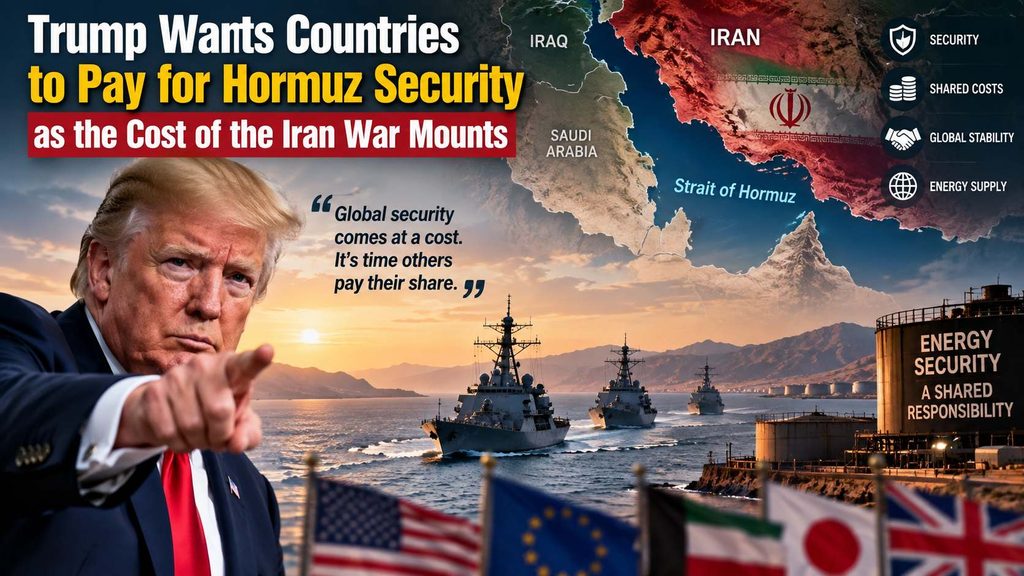
Trump’s comments do not represent a confirmed international reimbursement agreement. Rather, they signal a demand from Washington that countries benefiting from the security operation should contribute financially.
The timing is significant. The latest figures from the Congressional Budget Office show that the US war against Iran had already cost about $38 billion through August 1, with costs projected to increase by roughly $3 billion a month.
A Security Mission With a Price Tag
For decades, the United States has maintained a major military presence in the Gulf, while the Strait of Hormuz has remained a vital route for international energy supplies.
Trump’s latest argument puts a different price tag on that role.
His position is essentially that if American military forces are protecting a maritime corridor used by countries around the world to transport oil, those beneficiaries should share the expense.
In his social-media posts, Trump said petroleum was continuing to move through Hormuz and argued that the United States should be compensated after the military confrontation ends. He also complained that other countries had provided “no help whatsoever” during the conflict.
The proposal raises an obvious question: if the security of Hormuz benefits the global economy, should the cost of protecting it be carried primarily by American taxpayers?
That question could become increasingly important if the conflict continues.
Why Hormuz Matters So Much
The Strait of Hormuz is only a relatively narrow maritime passage, but its importance is enormous.
Before the war, roughly 20% of the world’s oil traveled through the waterway, according to the Congressional Budget Office report cited by Reuters. Disruptions there can therefore affect not only Middle Eastern producers but also fuel prices, transportation costs and inflation far beyond the region.
Think of Hormuz as a gateway for the global energy market. When that gateway operates normally, oil tankers can move between Gulf producers and international customers. When security deteriorates, the effects can spread quickly through energy markets.
That is why keeping commercial traffic moving has become a major military and economic issue.
Trump’s Reimbursement Demand Is Not New
Trump’s latest comments are not the first time he has raised the idea of making other countries pay for American security efforts around Hormuz.
In July, Trump told reporters that he wanted Gulf nations to reimburse the United States for helping protect the strait. Reuters reported at the time that Trump specifically said he wanted Gulf countries to pay for the American role in protecting the waterway.
The September comments therefore appear to reinforce an argument Trump has been making for months: countries that benefit from American military protection should contribute more toward its cost.
What has changed is the financial backdrop.
The US government is now facing a much clearer picture of how expensive the Iran conflict has become.
The $38 Billion Question
According to the Congressional Budget Office accounting reported by Reuters, the war had cost the United States approximately $38 billion through August 1. The estimate does not include some later strikes and attacks or the borrowing costs associated with financing the conflict.
The financial burden is not the only concern.
The CBO said the rapid use of American munitions could take years to replenish. Reuters reported that the agency estimated it could take as long as five years to rebuild some US stockpiles.
That makes Trump’s reimbursement argument part of a much larger conversation about the long-term cost of the conflict.
The question is no longer simply how much it costs to operate ships and aircraft in the Gulf. It also involves weapons, equipment, logistics, personnel, damaged military infrastructure and the broader economic consequences of the conflict.
Oil Flows Are Still Under Pressure
Trump’s comments came as oil transportation through the region remained disrupted.
Reuters reported in September that Gulf oil exports were still significantly below pre-war levels despite efforts by tanker operators to keep shipments moving. Some vessels have used covert or “dark” crossings, including turning off tracking systems, to navigate the region amid security concerns.
That illustrates why keeping Hormuz open is such a complicated task.
It is not enough for a tanker to have permission to sail. Shipping companies also need confidence that vessels, crews and cargoes can safely complete the journey.
A waterway can technically be open while still being commercially risky.
The Burden-Sharing Debate
Trump’s demand could also reopen a broader debate about how international maritime security should be financed.
The United States has traditionally played a major role in maintaining military capabilities in the Gulf. But the economic benefits of secure energy routes extend far beyond America.
Asian countries are major energy importers. European economies are also affected by global oil prices. Gulf producers depend on reliable shipping routes to reach international customers.
That creates a complicated financial question.
Should the country providing the largest military presence pay the majority of the bill? Should Gulf states contribute because their oil exports depend directly on the route? Or should the cost be shared more broadly among countries whose economies benefit from uninterrupted energy supplies?
Trump’s remarks put that debate directly on the table, although they do not establish how such a payment system would work.
Iran’s Position Adds Another Layer
The dispute is also connected to the unresolved question of who controls and regulates passage through the waterway.
The NDTV report said Iranian representatives have continued to assert authority over parts of the maritime environment and have maintained that ships should follow routes and procedures established by Tehran. Washington has rejected Iran’s broader claims regarding control of the strait.
That disagreement makes the security situation particularly complicated.
The United States is trying to facilitate commercial movement, while Iran has continued to contest aspects of the international security arrangement surrounding the waterway.
Meanwhile, commercial shipping companies are caught between military, political and economic pressures.
A Global Cost, Not Just an American One
There is another important side to the story.
Even countries that do not participate militarily in the conflict can feel its effects through higher energy prices.
The CBO said disruptions connected to the war and the Strait of Hormuz have contributed to higher energy prices and could add to inflation in the United States. Reuters reported that the agency projected a 0.5-percentage-point increase in inflation during the first three months of 2027 under its assessment.
That means the economic consequences of the conflict extend well beyond military budgets.
A tanker delayed in the Gulf can eventually become a higher transportation cost, a more expensive fuel bill or a more costly product somewhere thousands of miles away.
What Happens Next?
For now, Trump’s reimbursement demand is best understood as a political and financial proposal rather than an established international arrangement.
There is no publicly reported formula showing how much individual countries would pay, which nations would be included or how such payments would be collected.
Those details would become crucial if Washington attempts to turn the demand into a formal cost-sharing arrangement.
The larger issue, however, is already clear.
The security of the Strait of Hormuz carries a global economic value, but maintaining that security also carries a substantial military cost. As the United States spends tens of billions of dollars on the Iran conflict, Trump is arguing that America should not be left to shoulder the expense alone.
The debate could ultimately become as important as the military operation itself: who pays for keeping the world’s energy arteries open?
For Washington, Hormuz is increasingly being presented not simply as a strategic military responsibility, but as a service from which many countries benefit. Whether those countries will accept Trump’s argument that they should help pay for it remains an open question.
