The rubble across Gaza is becoming more than a symbol of destruction. It is increasingly becoming a vast repository of evidence about what happened during nearly three years of war.
Hundreds of human remains are still being recovered from collapsed buildings, in some cases years after families disappeared beneath the debris. Now the United Nations is calling for international investigators to be given access to all parts of Gaza so that bodies can be identified and evidence can be preserved before more rubble is removed.
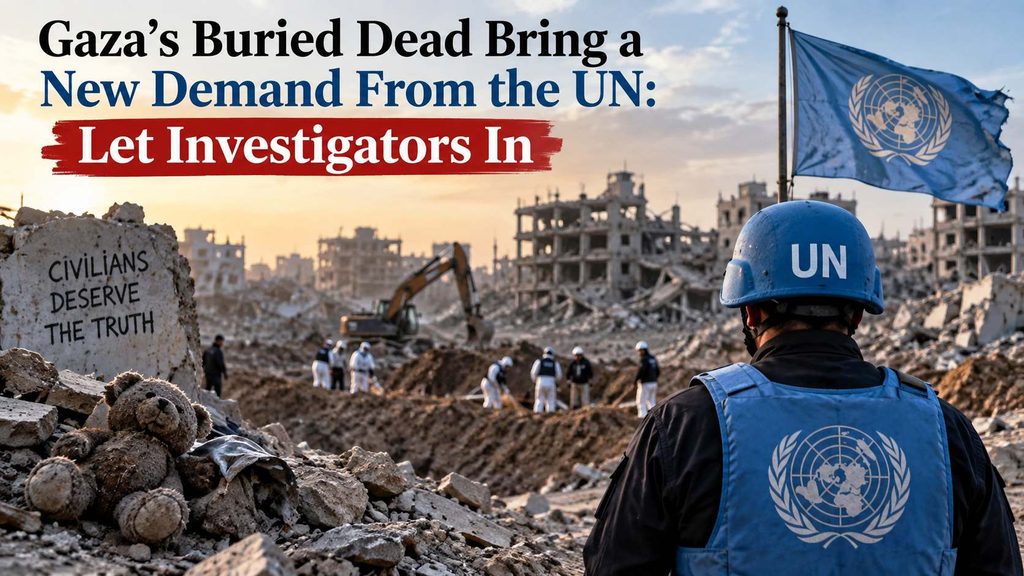
The UN Human Rights Office said on September 15 that more than 630 bodies and human remains had been recovered from beneath destroyed buildings across Gaza between November 2025 and September 2026, according to figures from the Palestinian Civil Defence. It also cited an estimate that more than 8,000 people remain missing beneath the rubble.
For the UN, the issue is no longer only about counting the dead. It is about determining who they were, how they died and whether the circumstances surrounding their deaths violated international law.
The Evidence Buried Under the Rubble
UN High Commissioner for Human Rights Volker Türk said many of the remains being recovered appear to belong to entire families, with women and children among those found.
That discovery has renewed concerns about possible violations of international humanitarian law and potential war crimes, the UN said. Türk stressed that the recovered remains may represent only a fraction of those still buried beneath Gaza’s devastated buildings.
The distinction matters.
Finding bodies in a war zone does not, by itself, establish that a war crime occurred. Determining responsibility requires evidence, forensic examination and investigation into the circumstances of each incident.
That is precisely why the UN is pressing for international investigators to enter areas of Gaza that remain difficult or impossible for independent investigators to reach.
Why Access Has Become So Important
Evidence can disappear surprisingly quickly.
Buildings can collapse further. Rubble can be moved. Personal belongings can be separated from remains. Biological material can deteriorate. The location where a body was found can become impossible to reconstruct.
The UN therefore wants investigators to document destroyed sites, identify victims, preserve forensic information and biological samples, record burial locations and help families learn what happened to missing relatives.
In other words, the race is not simply to remove the rubble.
It is also a race to preserve what the rubble can tell investigators.
More Than 630 Bodies Recovered
The figures emerging from Gaza show the enormous scale of the problem.
Palestinian Civil Defence reported that more than 630 bodies and other human remains had been recovered from beneath destroyed structures since November 2025. In one period between June 27 and August 27, authorities reported recovering 233 of 407 bodies believed to have been trapped beneath 20 destroyed buildings, most of them in Gaza City.
The UN says more than 8,000 people are still believed to be missing under the rubble.
That number is particularly significant because conventional methods of recording deaths become extremely difficult when entire buildings disappear and families cannot determine whether missing relatives were killed, displaced or remain somewhere else.
For those families, identification can provide an answer that has been missing for years.
The Human Cost Behind the Numbers
Statistics can make a war easier to describe but harder to understand.
The discovery of what appear to be entire families changes that picture.
According to the UN, remains recovered from destroyed residential areas have included women and children. Türk said families whose relatives disappeared for years are now confronting the possibility that their worst fears are being confirmed.
That creates another humanitarian responsibility: ensuring that the dead are recovered and identified with dignity.
For families, knowing where a loved one is buried can be as important as knowing the circumstances of their death.
The Rubble Is Also a Crime Scene
The UN’s concern extends beyond human remains.
The debris itself may contain physical evidence that could help establish what happened at particular locations.
That could include fragments of weapons, building damage, personal belongings, photographs, medical records and other material that helps reconstruct an attack.
UN Special Rapporteur Francesca Albanese warned earlier in September that large-scale removal and crushing of rubble could destroy evidence relevant to investigations into alleged international crimes. She said the recovery and identification of human remains and the preservation of evidence should take place under independent oversight.
This creates a difficult dilemma.
Gaza urgently needs rubble removed so roads can reopen, damaged areas can be made safer and reconstruction can begin. But removing that rubble without proper documentation could make future investigations much harder.
Israel’s Position
Israel has repeatedly said its military operations in Gaza are directed against Hamas and that it seeks to comply with international law.
The Israeli government has rejected allegations that its forces deliberately target civilians and has disputed accusations of systematic violations.
The UN’s latest statement, however, says the discovery of large numbers of remains from destroyed residential buildings warrants effective investigation into whether the rules governing the conduct of hostilities were followed.
The question therefore remains one for evidence and investigation rather than assumption.
Independent access would allow investigators to examine individual sites and establish facts that cannot reliably be determined from statements made by either side.
A War That Has Not Stopped Leaving Evidence Behind
The conflict began after Hamas-led attacks on Israel on October 7, 2023, which killed about 1,200 people and involved the taking of hostages, according to Israeli figures. Israel then launched a military campaign in Gaza that has caused enormous destruction and a very large Palestinian death toll.
Although a US-backed ceasefire reached in October 2025 halted large-scale fighting, violence has continued and the humanitarian consequences of the war remain severe. Reuters reported that more than 1,300 Palestinians had been killed since the ceasefire, according to Palestinian officials, while Israel and Hamas have continued to accuse each other of violations.
Meanwhile, the physical evidence of earlier fighting continues to emerge.
That is what makes the latest UN demand particularly significant.
The war may have moved into a different phase, but the process of documenting its consequences is far from over.
The Risk of Losing the Evidence
Gaza’s reconstruction will eventually require enormous quantities of rubble to be removed.
But investigators say reconstruction and accountability cannot be treated as completely separate processes.
If buildings containing human remains are demolished, crushed or cleared before investigators document them, important information could disappear permanently.
The UN has therefore called for international investigators to be allowed into all parts of Gaza to assist with evidence gathering.
The demand is essentially about creating a reliable record before the physical landscape changes forever.
Why Identification Matters for Justice
There is also a practical reason for independent investigations.
A credible investigation needs more than casualty figures. It requires names, locations, dates, forensic information and evidence about what happened.
Identifying victims can help establish whether people died together, whether particular buildings were occupied by civilians, and whether patterns emerge across different incidents.
Such information could eventually be relevant to legal proceedings.
The UN Human Rights Office has emphasized that evidence connected to alleged violations needs to be preserved because legal proceedings concerning the conduct of hostilities in Gaza are already ongoing.
A Second Battle Beneath the Rubble
The next stage of the Gaza conflict may therefore involve something less visible than missiles or ground operations: the struggle to preserve the historical and forensic record of what happened.
For families searching for missing relatives, the priority is identification and burial.
For investigators, it is evidence.
For humanitarian organizations, it is the safe recovery of remains.
And for governments and international institutions, it is the question of accountability.
The discovery of hundreds of bodies does not by itself settle the legal questions surrounding the war. But it makes those questions harder to postpone.
Gaza’s ruins are slowly being cleared, but beneath them remain thousands of unanswered questions.
The UN’s message is that those questions should be investigated before the evidence disappears.
In Gaza, clearing the rubble may be necessary for rebuilding. But preserving what is buried beneath it may be necessary for understanding what happened.