
Turkey’s latest crackdown on LGBTQ+ groups has entered a new phase.
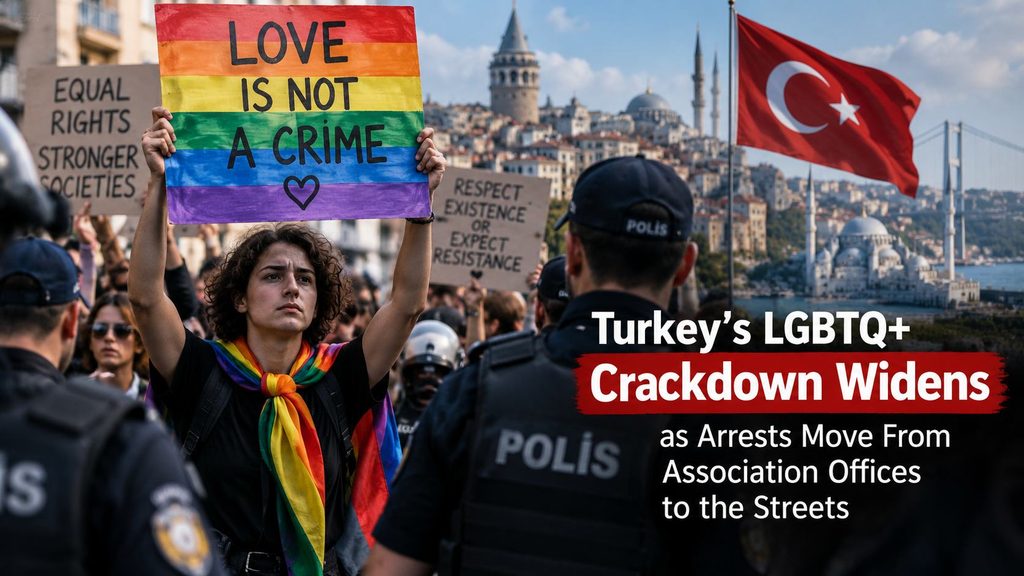
What began with raids on organizations and arrests across several provinces has now spilled into the streets, with police detaining protesters in Istanbul and Ankara while courts continue ordering suspects held pending trial.
On September 15, Turkish authorities arrested at least 31 people pending trial, according to lawyers, while police detained 126 protesters during demonstrations against the recent crackdown. The arrests included five transgender women in Ankara and 26 people in the southern province of Mersin.
The developments have turned a government investigation into a much broader confrontation involving LGBTQ+ organizations, activists, protesters, lawyers and international human-rights officials.
At the center of the dispute is a government campaign called “My Family is Safe.” Turkish authorities say the operation is intended to protect children and family values. Rights groups and opposition figures, however, have described the measures as an expanding campaign against LGBTQ+ people and civil society.
From Raids to Street Protests
The latest confrontation unfolded outside Istanbul’s Çağlayan courthouse.
A group had gathered to make a press statement concerning recent arrests, but police prevented the statement from taking place. Demonstrators protested and police intervened, with lawyers later reporting that 126 people had been detained during demonstrations in Istanbul and Ankara.
The arrests followed a series of raids on LGBTQ+ associations across Turkey.
In earlier operations, authorities searched association offices and detained dozens of people. The investigations have now expanded across 15 provinces and involve 162 suspects, nine associations and 13 businesses, according to Justice Minister Akin Gurlek.
The result is a rapidly widening legal and political confrontation.
Why the Government Says It Is Acting
Turkish authorities say the campaign is connected to allegations including prostitution and obscenity and that the investigation is intended to protect children and uphold family values.
Prosecutors have also said they had evidence suggesting children and minors were being improperly influenced regarding sexual orientation and gender identity.
Authorities have emphasized that the investigation concerns alleged criminal conduct rather than simply LGBTQ+ identity.
That distinction is important because same-sex relationships themselves are not illegal in Turkey. The current dispute instead concerns the government’s use of criminal investigations, restrictions and other measures against organizations and individuals associated with LGBTQ+ activity.
Courts Begin Ordering People Held
The crackdown has also moved into the Turkish judicial system.
A court in Izmir ordered 16 people to remain in jail pending trial on September 14 after authorities detained 18 suspects in the province. Two others were placed under judicial supervision, according to the local prosecutor’s office.
The following day, lawyers reported that at least 31 people had been jailed pending trial in the latest round of arrests.
Being held pending trial does not mean that those individuals have been found guilty. Their cases remain subject to judicial proceedings.
That distinction is particularly important as the number of arrests continues to attract international attention.
The Numbers Tell Only Part of the Story
The figures surrounding the crackdown have changed rapidly as new operations have taken place.
On September 13, prosecutors said 26 people had been detained during operations in 12 provinces, while Ankara prosecutors reported another 21 detentions connected to an investigation involving the LGBTQ+ organization Kaos GL. Kaos GL gave a higher figure, saying at least 50 activists had been detained.
By September 15, lawyers were reporting another 31 people jailed pending trial and 126 protesters detained during demonstrations.
The changing numbers reflect different stages of the operation rather than necessarily representing one single group of people.
Behind those statistics are organizations whose offices have been searched, activists taken into custody, protesters detained and online accounts restricted.
A Battle Over the Meaning of “Family Values”
The phrase “family values” has become central to the government’s explanation of the campaign.
President Recep Tayyip Erdogan has been promoting a broader “Decade of Family and Population” initiative, which is linked to concerns about Turkey’s declining birth rate and aging population.
The government presents the LGBTQ+ crackdown within this wider emphasis on family and population policy.
Critics see the situation differently.
Rights organizations argue that the government’s approach is increasingly restricting LGBTQ+ organizations and public expression under the justification of protecting families and children.
The disagreement therefore goes beyond the individual arrests. It raises a larger question about how far the state can go when it invokes family policy and child protection to restrict civil-society activity.
European Officials Raise Concerns
The crackdown has drawn criticism outside Turkey as well.
Michael O’Flaherty, the Council of Europe’s Commissioner for Human Rights, said he was concerned about the arrests, raids and online restrictions affecting LGBTQ+ civil society and human-rights defenders.
He argued that references to family values or child protection could not, by themselves, justify restrictions on human rights, and called for the release of people detained for human-rights or civil-society work.
The European Parliament’s Turkey rapporteur, Nacho Sánchez Amor, had also criticized the earlier arrests, describing them as a significant escalation.
These reactions show that the issue is no longer confined to Turkey’s domestic political debate.
The Internet Has Become Another Front
The crackdown is also taking place online.
Turkish authorities have blocked access to websites and social-media accounts belonging to various LGBTQ+ associations, activists and other organizations. Reuters reported that the X account of Amnesty International’s Turkey branch was among the accounts affected.
For civil-society organizations, online access is often essential for communicating with supporters, documenting arrests and organizing legal assistance.
Restrictions on digital platforms therefore add another dimension to the dispute.
The physical raids may target offices, but online restrictions can affect how information about the crackdown reaches the public.
Why the Protests Matter
The protests are significant because they demonstrate that the crackdown is producing a response beyond the organizations directly targeted by the investigations.
In Istanbul, protesters gathered outside a courthouse to challenge the arrests. In Ankara, police dispersed demonstrators attempting to assemble.
The scenes illustrate how quickly the issue has moved from courtrooms and association offices into public spaces.
For the government, maintaining public order is part of its stated justification for its actions.
For protesters and rights organizations, the ability to demonstrate and organize is itself part of the rights at stake.
What Happens Next?
The immediate future of the crackdown will depend heavily on the ongoing investigations.
Justice Minister Gurlek said the proceedings involve 162 suspects across 15 provinces, suggesting that the September arrests are part of a much larger investigation rather than an isolated operation.
More arrests or court decisions could therefore follow.
At the same time, international scrutiny is likely to continue, particularly over whether criminal investigations are being applied to specific alleged offenses or are being used more broadly against LGBTQ+ organizations and civil-society activity.
Those questions will ultimately need to be addressed through evidence and judicial proceedings.
A Crackdown That Is Getting Harder to Contain
Turkey’s latest LGBTQ+ controversy is no longer simply about raids on a handful of organizations.
It now involves courts, police operations, demonstrations, internet restrictions and an expanding investigation stretching across much of the country.
The government says its campaign is about protecting children and defending family values. Rights groups and European officials have raised concerns about the impact on freedom of expression, association and other human rights.
The most important development may therefore be the expansion of the issue itself.
What started inside association offices has moved into courthouses and city streets. And with dozens of people now facing detention or judicial proceedings, the debate over LGBTQ+ rights in Turkey is increasingly becoming a wider test of how the country balances public policy, criminal investigations and civil liberties.