A jump in fuel prices has turned into Syria’s broadest wave of protests since Bashar al-Assad was overthrown nearly two years ago, exposing just how difficult the country’s economic recovery remains.
Demonstrators have taken to the streets in several parts of Syria, burning tyres, blocking major roads and disrupting fuel transport after the government sharply increased prices for diesel, gasoline and gas.
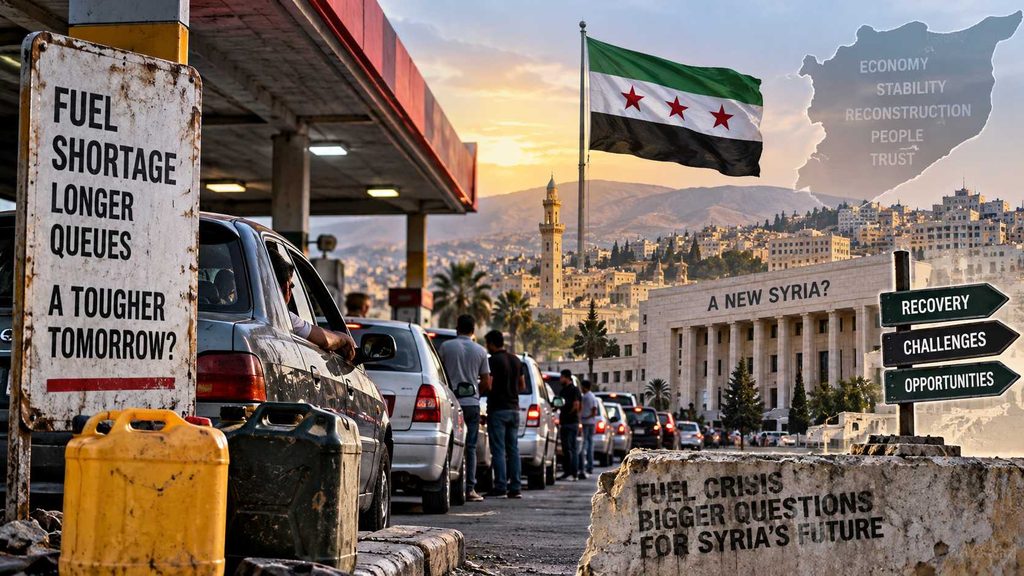
What began as anger over the cost of filling a vehicle has quickly become a broader expression of frustration over living costs, economic hardship and the performance of Syria’s new authorities.
The protests are particularly significant because they come less than two years after Assad’s fall. The government of President Ahmed al-Sharaa is trying to rebuild a country devastated by more than a decade of war, but the latest unrest shows how quickly economic decisions can become a political challenge.
A Fuel Increase That Hit an Already Struggling Population
The Syrian government raised the price of diesel by 40% on Saturday, taking it to 175 Syrian pounds per litre, according to Reuters. Gasoline prices were also increased, including a roughly 28% rise for 95-octane gasoline.
For many Syrians, however, the problem is not simply the percentage increase.
Fuel affects almost everything.
When diesel becomes more expensive, transportation operators face higher costs. Those costs can then spread to food deliveries, agricultural production, construction and public transport.
In a country where household budgets are already under enormous pressure, even a relatively small increase in the cost of transportation can quickly become a wider cost-of-living problem.
That helps explain why the fuel announcement produced such a rapid public response.
From Petrol Stations to the Streets
Protests were reported in cities and regions including Aleppo, Raqqa, Hasakeh and areas around Idlib.
Demonstrators burned tyres and blocked important roads, including the highway connecting Damascus with Aleppo. Some protesters also obstructed crude-oil tanker convoys.
In Aleppo, protesters voiced frustration not only over fuel prices but also over the wider distribution of resources and rising household expenses.
Some demonstrators called for the resignation of senior officials, including Energy Minister Mohammad al-Bashir.
That is an important development.
Once protests move from a specific price increase to demands for officials to leave office, the issue is no longer purely economic. It becomes a test of public confidence in the government itself.
Why Did the Government Raise Prices?
The government says it did not increase fuel prices arbitrarily.
The Energy Ministry has pointed to higher international procurement costs, Syria’s dependence on imported energy and disruptions to supplies. Reuters reported that reduced Russian crude exports and the temporary shutdown of the Baniyas refinery have added pressure to the domestic fuel market.
The broader global energy situation has also changed dramatically.
Renewed conflict across the Middle East has disrupted energy infrastructure and shipping routes, pushing international oil prices higher. Syria, with limited domestic refining capacity and damaged infrastructure, is particularly vulnerable to such external shocks.
But explaining why prices must rise does not necessarily make the increase easier for consumers to absorb.
That gap between economic necessity and household affordability is at the heart of the current protests.
Fuel Has Already Become Much More Expensive
The latest increase is not happening in isolation.
Since February, the price of 95-octane gasoline has risen by about 86%, while diesel prices have more than doubled, according to Reuters. Global crude prices, by comparison, have risen by about 44% over the same period.
That difference helps explain the intensity of public frustration.
For a Syrian household, fuel is not an abstract commodity traded on international markets. It is what powers cars, buses, generators, farm equipment and delivery vehicles.
When the cost rises repeatedly, people encounter the increase in multiple parts of everyday life.
A Crisis Built Over Years
Syria’s economic problems did not begin with the latest fuel announcement.
Years of war destroyed infrastructure, disrupted trade and weakened productive industries. The country has also faced sanctions, shortages and severe damage to its energy sector.
The result is an economy where millions of people have very little room to absorb another increase in basic costs.
The United Nations Development Programme estimates that around 90% of Syrians now live below the poverty line, compared with roughly one-third before the civil war began in 2011.
That statistic provides important context for the protests.
For people already struggling to afford food, transportation and other necessities, fuel increases can feel like a direct threat to household survival.
The Post-Assad Government Faces a Difficult Equation
Ahmed al-Sharaa’s government inherited an economy in extremely poor condition after Assad’s removal in December 2024.
The new authorities face two competing demands.
On one side, the government needs to rebuild infrastructure, restore energy supplies and establish more sustainable public finances.
On the other, it must keep basic goods affordable enough to prevent economic hardship from turning into wider social unrest.
Those goals can conflict.
Subsidizing fuel indefinitely can put pressure on government finances and encourage shortages. But removing or reducing subsidies too quickly can transfer the burden directly to households.
The latest protests demonstrate how sensitive that balance has become.
Why the Protests Matter Beyond Fuel
The scale of the demonstrations makes this more than a dispute over petrol and diesel.
These are among the widest protests seen since Assad’s fall, according to Reuters.
That makes them an early measure of how Syrians are responding to the economic policies of the post-Assad government.
The country underwent an extraordinary political transformation when Assad’s long rule ended. But political change does not automatically produce better living conditions.
For ordinary Syrians, the most immediate measure of recovery is often much simpler: Can they afford food? Can they travel to work? Can businesses operate? Can electricity and fuel be obtained at manageable prices?
The fuel protests suggest that economic expectations are becoming increasingly important.
The Global Energy Market Is Reaching Syria
There is also a wider lesson in the crisis.
Syria is being affected by events far beyond its borders.
Disruptions to Russian crude exports, turmoil in Middle Eastern energy markets and problems affecting international oil supplies can eventually reach Syrian fuel stations.
The country’s dependence on imported energy means that international price movements can quickly become domestic political problems.
The irony is that Syria is attempting to rebuild at precisely the moment when global energy markets remain unusually volatile.
The Government’s Challenge: Explain and Absorb
The authorities now face pressure to convince the public that the price increases are necessary while also addressing their impact.
The Syrian People’s Assembly has scheduled a session involving the energy minister to discuss the crisis, according to reporting from the Financial Times.
Whether that produces policy changes remains to be seen.
But the government’s response will matter because the protests are occurring at a sensitive moment in Syria’s transition.
A government can explain an economic shock. It cannot necessarily explain away the experience of people who suddenly cannot afford to travel to work or run a business.
A Warning From the Streets
The current protests do not necessarily indicate a return to the political upheaval that preceded Assad’s fall. Their immediate trigger is clearly economic, and the demonstrations have different local demands and circumstances.
But they do offer a warning.
Syria’s political transition will be difficult to sustain if improvements in governance are not accompanied by improvements in daily living conditions.
The government may be trying to build a functioning economy after years of destruction. Yet for many Syrians, the recovery will ultimately be judged not by economic plans or international announcements but by what happens at the fuel station, the grocery store and the family kitchen.
The Real Test Is What Comes Next
The fuel-price protests have exposed a problem that Syria cannot solve simply by reversing one price increase.
The country needs reliable energy supplies, functioning refineries, stronger infrastructure and an economy capable of reducing its dependence on expensive imports.
Those changes will take time.
In the meantime, the government must manage a population that has already endured years of war and economic deprivation.
The latest demonstrations show that patience has limits.
For Syria’s new leadership, the message from the streets is therefore larger than the price of diesel or gasoline: political change may have ended one era, but economic recovery will determine how the next one is experienced by ordinary Syrians.
