
The sons of former Pakistani Prime Minister Imran Khan have renewed their public campaign over their father’s imprisonment, saying they fear his worsening health and isolation could have serious consequences.
Kasim Khan and Sulaiman Khan, Khan’s two sons from his first marriage to Jemima Goldsmith, have accused Pakistan’s military leadership of subjecting their father to increasingly harsh conditions at Adiala prison in Rawalpindi.
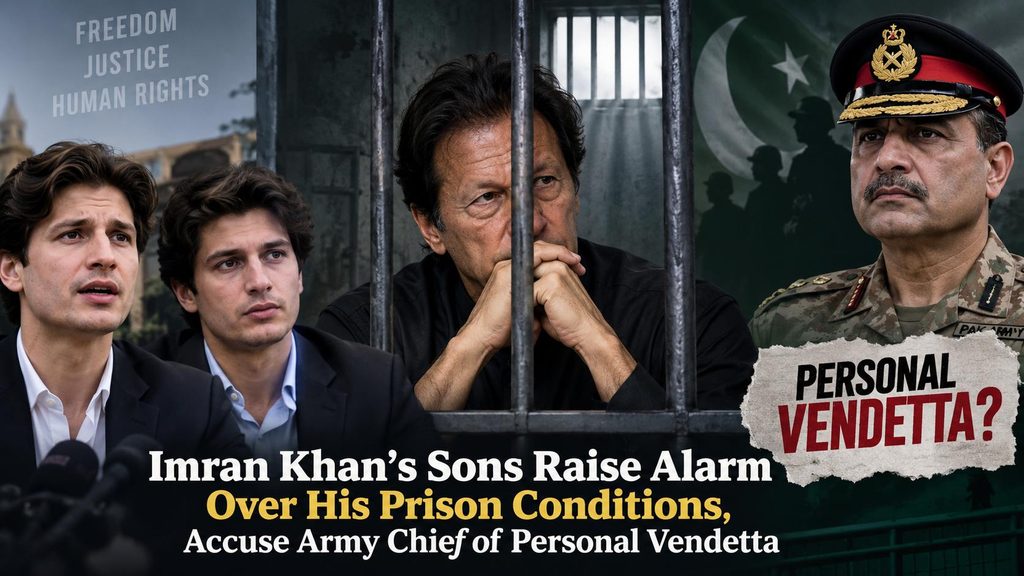
In interviews reported this week, the brothers alleged that Khan is being kept largely isolated, has limited contact with family members and is not receiving the level of medical attention they believe he needs.
They have also alleged that Pakistan’s army chief, Asim Munir, has a personal grudge against their father. These are allegations from Khan’s family and have not been independently established. Pakistani authorities have rejected claims that Khan is being denied adequate care.
Sons Say Their Father Is Being “Slowly Killed”
Sulaiman Khan described his father’s situation in stark terms, saying he believes the former prime minister is being “slowly killed.”
According to the brothers, Khan is spending most of his time inside a small cell and has been subjected to prolonged isolation.
They claim he has restricted access to family communication, reading material and independent medical care.
The allegations have intensified concerns surrounding the former prime minister’s wellbeing and have prompted his family to seek greater international attention to his circumstances.
Concerns Over Khan’s Health
The brothers have also raised concerns about their father’s physical health.
They say Khan has serious problems with his eyesight and blood pressure and that they are worried about whether he is receiving appropriate treatment.
The family has argued that an independent doctor should be allowed to examine him.
The Pakistani government, however, disputes the characterization of Khan’s detention conditions and has maintained that he has access to appropriate facilities and care.
That disagreement is central to the current controversy: Khan’s family describes the situation as dangerous isolation, while authorities reject the suggestion that he is being deliberately deprived of basic care.
Why His Sons Are Pointing to Asim Munir
Kasim and Sulaiman have specifically named Army Chief and Chief of Defence Forces Asim Munir in their allegations.
They argue that the treatment of their father is connected to a longstanding dispute between Khan and the military leadership.
The brothers have alleged that Munir’s actions are motivated by a personal grievance dating back to Khan’s time as prime minister.
The claim has been made publicly by Khan’s family, but the alleged motive has not been independently established.
From Prime Minister to Prisoner
Khan’s political journey makes his imprisonment particularly significant in Pakistan.
He served as prime minister from 2018 until 2022, when his government was removed following a parliamentary no-confidence vote.
After leaving office, Khan became involved in an increasingly intense confrontation with Pakistan’s political and military establishment.
He was arrested in 2023 and has remained in custody while facing multiple legal cases. He is currently serving a 14-year sentence in a corruption case, according to recent reporting. Khan and his Pakistan Tehreek-e-Insaf party have repeatedly argued that the legal cases against him are politically motivated.
A Conflict That Has Continued Behind Prison Walls
Khan’s imprisonment has not ended his political influence.
His supporters continue to demand his release, while his family has increasingly focused on his treatment and health.
His sons, who live outside Pakistan, have become some of the most visible international voices speaking about his detention.
Their latest statements are therefore about more than prison conditions. They are also part of a wider struggle over how Khan’s imprisonment should be understood — as the consequence of criminal convictions, as a political confrontation, or as both.
Different sides continue to present sharply different accounts.
International Attention Grows
The controversy surrounding Khan’s detention has also attracted attention outside Pakistan.
Recent international appeals have focused on whether the former prime minister is receiving humane treatment and appropriate medical care, separate from questions about the legal merits of the cases against him.
That distinction is important.
Concerns about the treatment of a prisoner do not necessarily resolve the legal questions surrounding his convictions. Likewise, disputes over those convictions do not by themselves establish whether prison authorities have violated his rights.
What Happens Next?
For Khan’s sons, the immediate priority is their father’s wellbeing.
They are calling for greater access to him, medical attention and clearer information about his condition.
For Pakistani authorities, the issue remains intertwined with a much broader political confrontation that has continued since Khan left office.
As the dispute continues, independent information about Khan’s health, prison conditions and access to medical care will remain important in assessing the competing claims.
For now, his sons say they fear for their father’s life. Pakistani authorities reject the suggestion that he is being deliberately harmed.
The disagreement leaves one of Pakistan’s most consequential political figures at the centre of another controversy — this time focused not on an election or courtroom, but on what is happening to him behind the walls of Adiala prison.