
Every unanswered phone call carries a question that families of missing flood victims in Nepal and China cannot escape: Could their loved ones still be alive?
Weeks after a devastating glacial collapse sent torrents of mud and rocks through the Himalayas, families are continuing a desperate search for relatives who disappeared near the Nepal-China border. Hospitals, government offices, family WhatsApp groups and mobile-phone location services have become part of an effort to find answers in the aftermath of one of the region’s deadliest recent disasters.
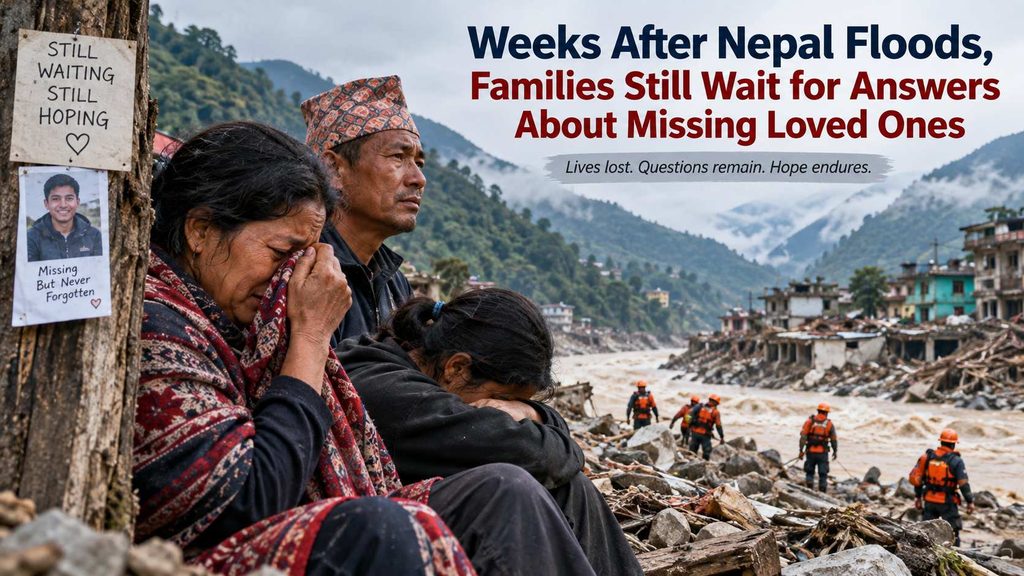
For some families, the hope of a rescue remains alive. For others, the absence of information has become a painful uncertainty that makes it difficult to grieve or move forward.
The disaster has left at least 1,386 people dead in Nepal, with 5,130 still reported missing. In China, 43 people have died and 519 remain unaccounted for, according to Reuters’ September 15 report.
A Last Message From the Border
For Arushi Gupta’s family in India, the search began with a short WhatsApp message.
The 33-year-old consultant from Hyderabad had travelled to Nepal on August 23 for a pilgrimage to Mount Kailash. On August 26, she sent her father, Ajay Gupta, a photograph of the Gyirong Port immigration post and wrote that she was about 15 minutes from the border.
It was the last message her parents received from her.
Before that, Arushi had been sharing ordinary details of her journey: a cup of tea at a hotel, travel tablets and a fellow traveller’s forgotten passport. Those small updates now form a painful record of the final hours before communication stopped.
Her father believes she may have crossed into Tibet and reached a safe place. He has held on to that possibility despite the absence of any confirmed news.
The Search That Took Families Across Borders
Three days after the flood, Ajay Gupta and three relatives travelled to Kathmandu. They visited hospitals, checked lists of missing and dead people, and spoke with embassy officials and police.
He also provided a DNA sample to assist with identification if human remains were recovered.
The family collected Arushi’s suitcase from the hotel where she had left some belongings before beginning her pilgrimage. For her father, returning to the hotel was more than a practical task. It brought back memories of the daughter who had been there only days earlier.
Families of other Indian pilgrims formed a WhatsApp group of around 200 members to exchange information. At first, they held regular evening calls to share updates. As the search continued and information became less frequent, the group’s activity declined.
Yet the need for answers has not diminished.
A Mother Missing, a Daughter Waiting
Arushi’s story is echoed by families in other countries.
In Norway, 22-year-old Ukrainian film student Vladyslava Horlova is waiting for news of her mother, Elena, who disappeared near the border while travelling with a Ukrainian spiritual retreat group. Representatives of the families say Elena and 46 other Ukrainians on the trip remain missing.
Horlova has been keeping her phone’s ringer at maximum volume, hoping that a call might come at any hour.
She sent her mother a message the day after the flood asking, “Did you land?” It has not been read.
The silence has left her searching for even small pieces of information that might explain what happened.
When Technology Becomes a Search Tool
For families separated from their loved ones by a disaster, technology can provide clues when traditional searches produce little information.
Horlova checked Apple’s Find My service and found that her mother’s iPhone was last seen on the Chinese side of the border, while her Apple Watch and AirPods were last seen on the Nepalese side.
The family has asked Apple for assistance, hoping that device information might help establish where Elena was when the flood struck.
Arushi’s family has also sought help with digital location data. Sachin Joshi, whose brother and sister-in-law were travelling with Arushi’s group, asked India’s foreign ministry to seek assistance from mobile operators.
But digital clues are not the same as proof of survival. A last known location can show where a device was detected, but it cannot by itself establish a missing person’s condition or whereabouts.
Why the Search Has Become So Difficult
The scale of destruction has made the search exceptionally challenging.
The glacial collapse triggered a flood that swept through valleys, damaged infrastructure and buried areas under an estimated 2.2 million tons of debris, according to officials cited by Reuters.
Roads, bridges and other access routes were damaged. Search teams have also had to contend with difficult terrain and the possibility of people being trapped in tunnels.
The disaster has already produced remarkable rescues. Hydropower workers trapped underground in Nepal were found alive, including Sanjay Sah, who survived nine days inside a tunnel before rescuers reached him.
Those rescues have given families another reason to keep hoping.
But each passing day without information also increases the emotional burden on those waiting.
A Rescue Effort That Crosses Borders
Nepalese and Chinese authorities have said they are coordinating efforts to locate missing people and provide information to families. India has also said it is working with the two countries.
The Chinese foreign ministry told Reuters that relatives would be informed promptly if new information became available and that a hotline for families worldwide was available.
However, families continue to report difficulty obtaining regular updates.
For those whose relatives disappeared near the border, the international nature of the disaster has added another layer of complexity. Families may need to communicate with authorities in several countries, deal with different systems for reporting missing people, and wait for information from areas they cannot easily reach themselves.
DNA Testing Offers a Path to Identification
DNA samples have become an important part of the search for families whose relatives remain missing.
When bodies or human remains are recovered but cannot be identified visually, DNA testing can help authorities establish identity. It may also allow families to receive confirmation about what happened to their loved ones.
For the relatives of Arushi and Elena, however, providing samples has not yet brought the answers they seek.
A DNA sample is a practical step in a difficult investigation. It does not, on its own, confirm whether a missing person is alive or dead.
The Human Cost of Waiting
The flood has destroyed homes, infrastructure and livelihoods, but its impact extends far beyond the physical damage.
Families are living with disrupted routines, financial pressure and the emotional strain of uncertainty. They are trying to maintain contact with authorities while continuing their own searches.
Some have travelled to Nepal. Others have contacted embassies, police departments and technology companies. They are doing what they can with the information available to them.
For families separated by thousands of kilometres, the search is not simply a matter of finding a name on a list. It is an effort to recover a connection that has been interrupted without explanation.
Hope Remains, Even as the Search Continues
The lack of confirmation has left many families holding on to the possibility that their loved ones survived.
Arushi’s father is planning another trip to Nepal with his wife and Arushi’s husband. He continues to believe that she may still be alive.
“Miracles do happen,” he told Reuters.
That hope is shared by families across Nepal, India, China and other countries affected by the disaster.
For now, the search continues amid damaged landscapes, incomplete information and long periods of silence.
The flood may have passed, but for the families of the missing, the disaster is not over. They are still waiting for a message, a confirmed sighting or any evidence that could finally tell them what happened to the people they love.