Nearly five decades ago, an armed group turned Islam’s holiest mosque into the centre of a nearly two-week confrontation that stunned Saudi Arabia and Muslims around the world.
The events of November 1979 remain one of the most extraordinary episodes in modern Saudi history. Hundreds of armed men seized the Grand Mosque in Mecca, took up positions across the vast complex and announced that a religious figure they identified as the Mahdi had appeared.
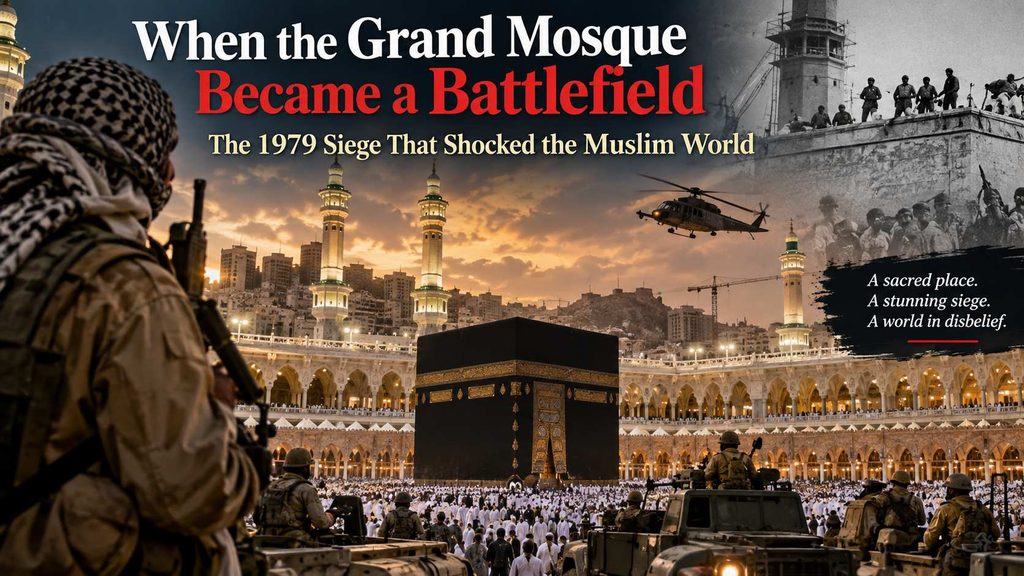
The crisis eventually required Saudi security forces to fight their way through the mosque and its underground areas. The final stage involved pumping gas into the passages where the remaining militants were hiding.
The episode is now being recalled after Mecca was placed under an emergency alert in September 2026 following a reported drone threat. Saudi authorities said their air defences intercepted and destroyed a Houthi drone south of the holy city, while the Houthis denied targeting Mecca. The circumstances were completely different from 1979, but the latest alert has brought renewed attention to the extraordinary history of security threats surrounding the holy city.
The Morning the Grand Mosque Was Seized
It was shortly after the Fajr prayer on November 20, 1979, when worshippers inside the Grand Mosque began to realise that something was seriously wrong.
Thousands had gathered at Masjid al-Haram, the enormous sanctuary surrounding the Kaaba.
Then came the sound of gunfire.
At the centre of the takeover was Juhayman al-Utaybi, a former Saudi National Guard corporal and religious preacher. He and his followers had entered the mosque carrying weapons that had reportedly been concealed inside coffins brought into the complex under the guise of funeral rituals.
The operation was not a small disturbance. Roughly 600 militants spread through the mosque and occupied strategically important areas, including minarets, corridors and underground sections.
For worshippers caught inside, an ordinary morning of prayer had suddenly become a hostage crisis and armed confrontation.
A Claim That Changed the Nature of the Rebellion
The militants were not simply demanding political concessions.
They announced that Mohammed Abdullah al-Qahtani, Juhayman’s brother-in-law, was the Mahdi — the divinely guided figure whose coming is described in Islamic tradition.
The declaration gave the rebellion a religious dimension and was intended to challenge the Saudi ruling establishment.
Juhayman and his followers accused the Saudi monarchy of abandoning Islamic principles, embracing excessive modernisation and allowing Western influence to reshape the kingdom.
Their rebellion therefore emerged from a broader confrontation over religion, political authority and the direction of Saudi society.
Why Retaking the Mosque Was So Difficult
The Saudi authorities faced an extraordinary problem.
The militants were inside Islam’s holiest sanctuary, where fighting and the use of force carried profound religious implications. Security personnel initially had limited ability to respond, while the armed group had already occupied advantageous positions throughout the complex.
Saudi forces established a security cordon around the mosque and brought in military and special forces units.
But entering the building was only the beginning.
The militants had turned the mosque’s architecture into a defensive network, using elevated positions and underground areas to resist attempts to remove them.
A Religious Ruling Was Needed
Another complication was the sacred status of the Grand Mosque.
Saudi authorities sought guidance from senior Islamic scholars before launching a full military operation inside the sanctuary.
A religious ruling was eventually issued permitting the use of force to remove the armed group.
That decision opened the way for a much more aggressive operation.
Saudi forces began retaking sections of the mosque, but the militants withdrew deeper into the complex.
The confrontation moved underground.
The Battle Moves Beneath the Mosque
As the operation continued, the remaining fighters took refuge in underground rooms and passages.
What authorities initially expected to be a rapid security operation had become a prolonged battle.
The siege continued for almost two weeks, turning the Grand Mosque into a battlefield unlike anything Saudi Arabia had experienced in modern times.
Saudi Arabia eventually sought specialist assistance from France. A small French team discreetly helped develop methods for clearing the underground areas.
The final phase would involve one of the most controversial and dramatic elements of the entire operation.
How the Militants Were Forced Out
Saudi forces drilled holes into the underground areas where the remaining militants were believed to be hiding.
Gas was then pumped into the passages in an attempt to force them out and break their resistance.
The strategy eventually succeeded.
By the early hours of December 5, 1979, Juhayman and the remaining rebels surrendered. The group that had originally numbered around 600 had been reduced to slightly more than 100 by the end of the siege.
Juhayman himself was captured alive.
What Happened After the Siege
The story did not end with the surrender.
On January 9, 1980, Juhayman and 62 other captured rebels were publicly executed in several Saudi cities, including Mecca and Medina. NDTV describes the executions as the largest mass execution in Saudi Arabia’s modern history.
But the consequences of the siege went far beyond those directly involved.
The occupation had exposed tensions within Saudi society and challenged the monarchy’s religious legitimacy.
The government’s response included a stronger emphasis on religious conservatism and enforcement of religious rules in the years that followed.
The effects of the 1979 uprising would influence Saudi social and religious life for decades.
A Kingdom Changed by One Extraordinary Crisis
The Grand Mosque siege happened at a pivotal moment.
Saudi Arabia’s oil wealth was transforming the country rapidly. New infrastructure, economic development and growing contact with the outside world were changing everyday life.
Juhayman and his followers viewed many of these changes as evidence that the kingdom was moving away from what they considered authentic Islamic principles.
The rebellion therefore cannot be understood simply as an attack on a building.
It was also a violent confrontation over who should define Saudi Arabia’s religious and political future.
Why the Story Still Matters Today
The 1979 siege has returned to public attention because of the latest security concerns around Mecca.
In September 2026, Saudi Arabia issued an emergency alert for Mecca amid an escalation involving Yemen’s Houthis. The alert was later lifted, and Saudi authorities said their air defences had intercepted a drone south of the city. The Houthis denied targeting Mecca.
The comparison, however, has important limits.
The 1979 crisis was an internal armed uprising in which militants physically occupied the Grand Mosque.
The 2026 incident involved a reported aerial threat that Saudi Arabia said was intercepted before reaching Mecca’s restricted airspace.
They are separated by almost half a century and arose from entirely different circumstances.
What connects them is the extraordinary sensitivity surrounding the holy city.
Mecca’s Security Has a Meaning Beyond Borders
For Saudi Arabia, protecting Mecca is not merely a matter of national security.
The city is home to the Kaaba, the focal point of Muslim prayer, and the Grand Mosque, Islam’s holiest sanctuary.
Millions of Muslims around the world look toward the Kaaba during their daily prayers, while millions more travel to Mecca for Hajj and Umrah.
That makes any security threat involving the city far more consequential than an ordinary attack on infrastructure or territory.
The events of 1979 demonstrated just how dramatically a crisis inside the sanctuary could unfold.
Almost 47 years later, the circumstances may be different, but the importance of keeping Mecca secure remains unchanged.
The 1979 siege is therefore remembered not simply as a dramatic chapter in Saudi history, but as a moment when a place regarded by Muslims worldwide as a sanctuary became the scene of an armed confrontation — an event whose political, religious and social consequences continued long after the last gunmen surrendered.